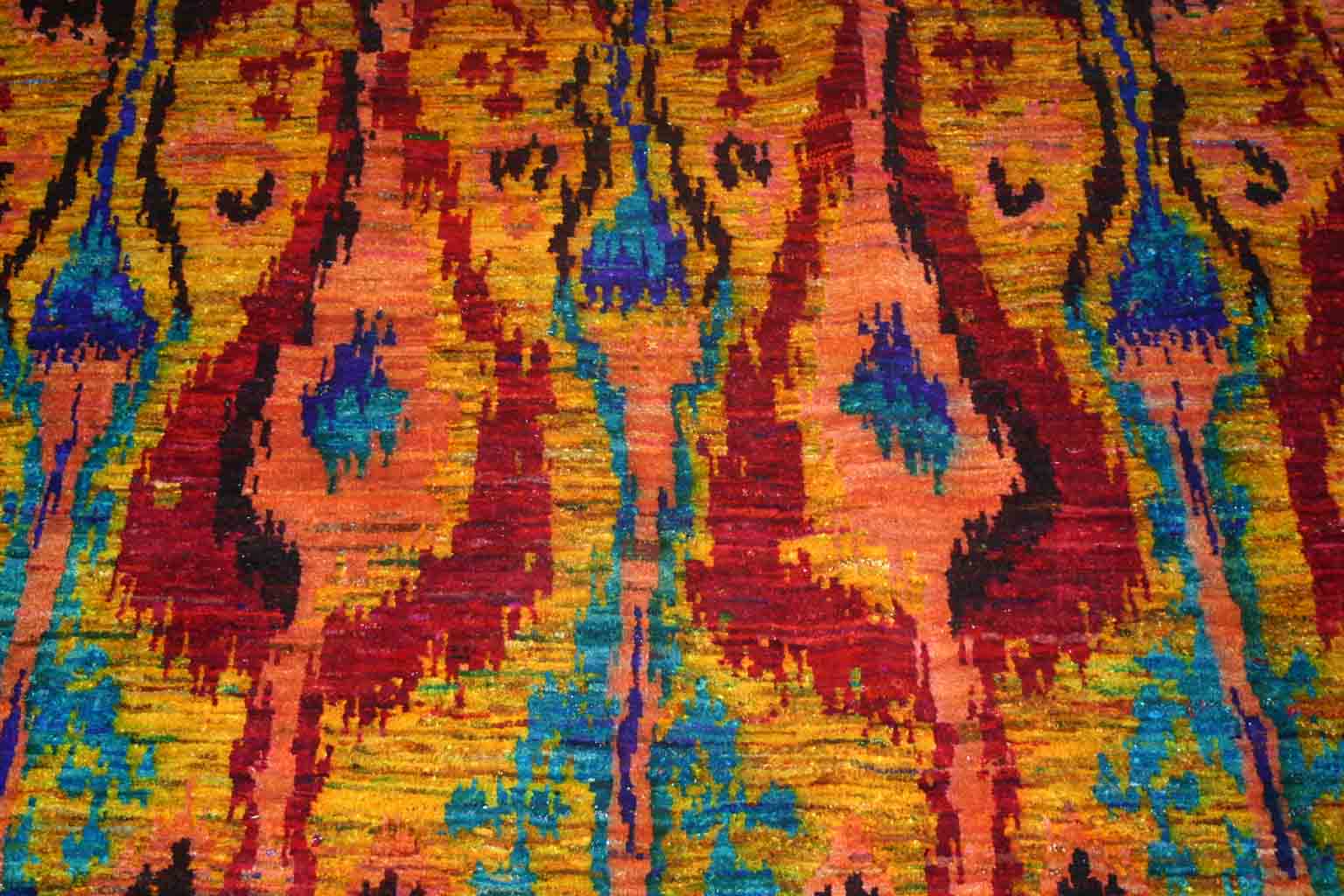
A lot of people wonder what actually goes into the process of making a hand-woven rug. Well, the simple answer is A LOT. To make a rug involves a detailed series of processes and this blog is designed to demonstrate, using video, the extent of work that is involved. If you look at these videos you will certainly have a great appreciation for the amount of work and attention to detail that is required. In turn, you will never look at a hand-woven rug the same way again!
All of these videos were taken in India, which, today is one of the major sources of hand-woven rugs.
Step 1. Yarn.
Yarn, Yarn, Yarn. It's all about the yarn! Nearly all of the wool used in Indian production today is from New Zealand, which is famous for its high quality. You may wonder how manufacturers of these rugs can afford to use such high quality yarn and turn a profit. The simple answer to that is that there are a lot of sheep in New Zealand, and, again I mean A LOT. You should go there and see for yourself. So if you want to see some yarn in a typical rug-making facility, then check out this video...
But yarn is no good unless it is spun. You know the term 'spinning a yarn?' Yep, this is where it is from. So take a look at these wizards of yarn spinning...
Step 2. Design.
It is no understatement to say that when most people see the amount of preparatory work involved in designing the rugs it BLOWS THEIR MINDS! Indeed, when I first saw it myself I could hardly believe it. Whatever the design, whether it be a reproduction of an antique Persian rug, a contemporary Jackson-Pollock-Threw-Paint-At-A-Wall design, an Arts & Crafts design, or a reproduction of an antique Navajo rug, each piece is individually designed on grid-paper at a scale of 1:1. Yes, that's right - 1:1! Each, single individual knot that has to be sown is colored-coded and provides a template for the weaver to follow. Take a look at this video and you'll see what I mean...
Step 3. Weaving.
Once these fundamentals are in place we can move on to the task that most people are familiar with - weaving. First of all, in order to weave a rug, you need to have a loom. All of the looms used in India are large, upright, wooden structures. On these looms are strung the cotton threads that serve as the foundation of the rug. The threads are string vertically and horizontally, crossing over each other and thus forming a grid. These threads are known as the warp and weft threads.
Weavers sit at right angles to the loom, so that the grid of threads is in front of them. Following the grid template provided by the designers, the weavers tie a knot around each threads using the appropriately dyed yarn. As you can imagine this is the most labor intensive part of the job. It can take two weavers months to complete a rug.
In this first video you can see how the looms are lined up in a rug weaving compound. This video gives you a bit of an idea for the feel of a rug-weaving facility...
This next video really shows a weaver in action. Check out how fast he ties a knot and cuts the yarn off. Crazy!
Step 4. Clipping.
Alright then, the rug is woven and is taken down from the loom. When it comes off the loom any rug is unrecognizable from the finished product, the reason being that it is about as shaggy as a yak. The yarn pile, now knotted in place, has to be clipped down to a consistent height. Only then will the design of the rug become apparent. Also, depending on the type of rug being made, the pile can be cut to various heights. Some pieces, designed to be reproductions of antique rugs, can be quite quite low to the foundation, the reason being that most antique rugs have had their pile worn down over the years.
Their are two methods of clipping. Most of the preliminary clipping is done using this machine - kind of like a cross between a hand-held lawn mower and a hovercraft. The operator of this machine has to be on his or her game, because the slightest distraction can result in a large area of the pile being cut much lower than the rest of the rug. Now THAT is a pretty major stuff-up, considering all of the work that the poor old weavers have done, right? No room for messing up here!
My apologies here but I don't have any video to illustrate this part of the process - just photos...
The traditional way to clip comprised using hand-shears. Now I DO have a video of this being done so take a look. This is how it was done in the old days but you still see the shears being used here and there, especially when it comes to the finer, finishing stage of clipping.
Stage 5. Realignment.
Throughout the previous stages the rows of knots tend to get moved around. Once the rug is clipped it is laid out flat, with the warp and weft strings strung out tight. Then, using aligning tools, the knots are moved into position and packed down nice and tight so they are in the correct place and won't move around any more. These videos show you what it looks like...
Step 6. Tying Off The Foundation.
Well then, the rug is really looking like a rug now, yes? Now it's time to the small details. The first thing to do is tie off the foundation. What this means is detaching the vertical warp strings and tying them off with sturdy little knots. If this doesn't happen, then, as you can imagine, the whole rug will fall apart and all of the piled knots will fall out. Usually, a length of the warp string is left extending beyond the knots. This is the fringe. Most people think that fringe is just decorative. But here you see that the fringe is actually the very foundation of the rug itself. The fringe can be any length you want - in that regard it IS decorative. But the critical thing here is the knot. You can cut the fringe back to the warp knot but if you cut the knot you're going to have some trouble. This is how the process looks...
OK then. Now the warp strings of the foundation have been tied off. The same thing needs to happen with the weft strings, except here the final finish is different. The knots are covered up in a running loop of yarn called 'the selvedge'. This video shows you what the process entails - it is much more rapid work than finishing the warp strings and the fringe...
Step 7. Final Removal Of Imperfections.
We are almost done. Now the rug just needs a good, final going-over and then a wash. The following video shows how workers search the pile, clipping off any pieces of yarn that have been missed and stand higher above the cut level of the pile. The other main imperfection that has to be fixed involves locating any yarn that is lying flat, hidden in the pile, and thus avoided the clipping process. Over time, such cheeky little rascals will 'pop-up' out of the pile. Guess what they are generally known as? You got it - 'pop-ups'. These have to be pulled out and clipped. Here you see the process...
Step 8. Washing.
Well, not much to explain here. It's time for the rug to be given a good, refreshing wash. This is also part of giving the final warp and weft strings a solid going-over. Any that tighten up when they get wet will be stretched out. Check it...
Step 9. Stretching the Rug.
Now the poor old rug is 'put on the rack'. All those warp and weft strings need to be stretched out nice and tight so they don't go doing quirky things that could make the rug bunch up or lose it's shape. Here is a video of the rug on the rack! These images may offend some viewers...
Step 10. Into Storage And Off For Sale!
Your rugs are ready! Just take a look at this video and try to comprehend how much work went into making all of these rugs. It's a huge industry providing employment for thousands upon thousands of people, giving people a livelihood, a better future, and making a fine product that can be enjoyed and appreciated for decades.